x




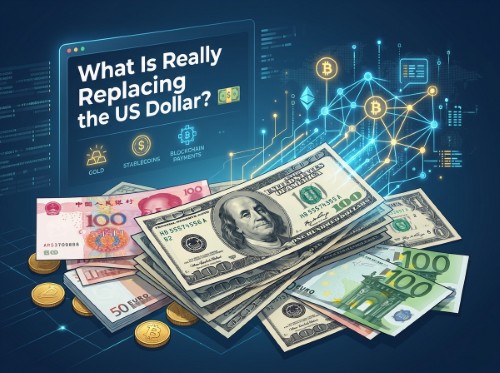
Headlines frequently proclaim the imminent collapse of the United States dollar, yet the Greenback remains firmly at the centre of global commerce. Despite periodic market fluctuations, the currency continues to underpin international finance. However, beneath this surface stability, profound structural shifts are quietly disassembling the traditional dollar hegemony piece by piece. Central banks are accumulating gold at record rates, and the dollar’s share of global foreign exchange reserves has gradually drifted from over 70 per cent two decades ago to the high-50s today.
Understanding the future of global money requires looking past sensationalist claims of a sudden currency crash. The dollar is not simply disappearing; its role is evolving as the international financial architecture fragments into competing systems.
To evaluate the strength of the dollar, one must recognise that it is not a monolithic tool, but rather a bundle of four distinct financial functions:
Each function possesses a vastly different barrier to entry and exit. Reallocating central bank reserve savings into alternative assets can be accomplished relatively quickly. Conversely, untangling trillions in dollar-denominated debt and financial collateral is exceptionally difficult, as sovereign entities and corporations remain legally obligated to service their debts in dollars regardless of macroeconomic policy shifts.
A major turning point for global central banking occurred when G7 nations immobilised approximately $300 billion in Russian central bank assets. This action reshaped international reserve strategy, demonstrating to monetary authorities worldwide that sovereign reserves held in foreign jurisdictions carry significant political counterparty risk.
In response to these developments, central bank demand for physical gold has surged. Official purchases have nearly doubled compared to pre-2022 averages, with institutions across emerging and developed markets seeking neutral, unencumbered assets that carry no custodial risk. Physical gold provides an independent reserve that cannot be frozen or altered by external sanctions, making it the primary choice for central banks seeking to diversify their national balance sheets.
Rather than rallying around a single competing currency—such as the Euro or the Chinese Yuan—the global financial system is splitting into distinct economic blocs. Sovereign nations are increasingly establishing bilateral payment mechanisms, localised clearing channels, and alternative energy settlement platforms to process cross-border transactions in local currencies.
While these non-dollar payment rails often carry higher operational costs, slower settlement speeds, and reduced market liquidity compared to traditional banking networks, participating nations view them as necessary insurance. Sovereign governments are proving willing to pay a premium for secondary financial infrastructure that operates independently of Western financial dominance.
Paradoxically, while foreign governments attempt to limit their reliance on the dollar, private citizens in developing economies are adopting it faster than ever before. The rapid expansion of dollar-backed stablecoins on public blockchain networks has created an alternative channel for global dollarisation.
In economies facing high domestic inflation or strict capital controls, individuals and businesses are turning to digital dollars to preserve purchasing power and execute transactions. Major stablecoin issuers hold tens of billions of dollars in short-dated United States Treasury bills to back their tokens, effectively turning global crypto users into significant indirect purchasers of government debt. As a result, digital infrastructure is expanding the transactional reach of the dollar directly to individuals, even as sovereign state institutions attempt to pivot away.
Alongside digital dollars, decentralised assets such as Bitcoin are fulfilling a distinct role in the modern financial landscape. While stablecoins provide transactional convenience, Bitcoin serves as a hedge against fiat currency debasement and institutional counterparty risk.
Market participants who lack the scale or regulatory capacity to acquire tons of physical gold are increasingly turning to scarce, non-sovereign digital assets. This dual trend highlights the twin tracks of modern finance: market participants continue to utilise the dollar for its unmatched liquidity and convenience, while simultaneously building independent hedges against systemic monetary expansion and centralized financial control.
Coin Bureau - What's Actually Replacing the US Dollar?
"Are the headlines about the death of the US dollar true, or just noise? We dig into the facts. Gold reserves hitting highs, new payments tech, and the role of US debt, showing how the dollar isn’t dying, but changing shape in markets where your money is on the line.
Discover why central banks race for gold while regular people stack stablecoins and Bitcoin, and why no currency is stepping in to take the dollar’s place. See how these changes could impact your savings, crypto, and international finance in the years ahead."
~ TIMESTAMPS ~
0:00 – Is the US Dollar Actually Dying?
0:54 – The Dollar’s 4 Secret Jobs Revealed
2:28 – The $300B Event That Changed Money Forever
4:38 – The Secret War Against the Dollar
7:22 – Crypto Is Quietly Saving the Dollar
9:57 – Bitcoin: The Ultimate Dollar Hedge?
Source: 👉 https://www.youtube.com/watch?v=sEgOXMfJTLU
Disclaimer: This article is provided for informational purposes only, mistakes may be made, and it's not offered or intended to be used as legal, tax, investment, financial, or any other advice.