x




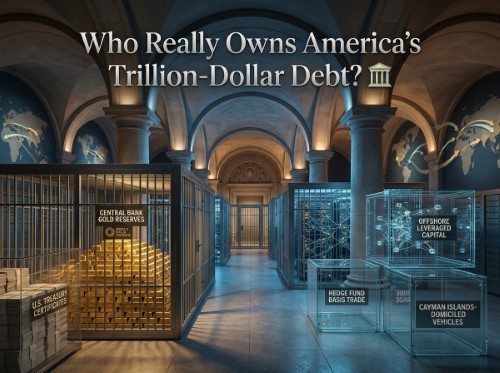
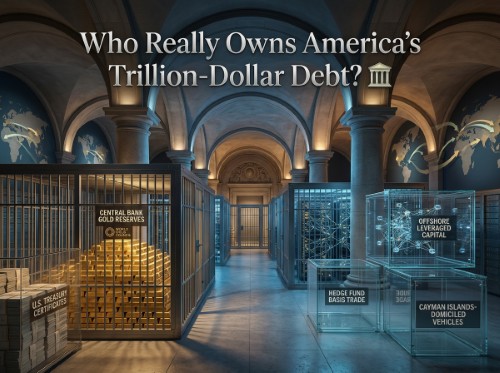
For decades, the standard narrative surrounding American national debt was remarkably straightforward. Whenever commentators debated who held the purse strings of the United States, the answer usually pointed towards foreign governments: China amassing mountains of paper, Japan holding the top spot, and Gulf states funnelled petrodollars back into US Sovereign Debt.
That textbook explanation made sense a decade ago. Today, however, it is dangerously out of date.
Recent Treasury International Capital (TIC) data analysed by OMFIF reveals a profound structural shift in global finance. Foreign central banks and official state institutions no longer dominate the foreign ownership of US Treasuries. Instead, a complex mix of leveraged hedge funds, offshore domiciles, and private speculative capital has quietly taken their place—while central banks themselves pivot toward physical gold.
Understanding who actually owns US debt in 2026 is not merely an exercise in accounting trivia; it directly impacts market volatility, currency credibility, and the stability of global finance.
As of mid-2026, foreign investors hold approximately $9.3 trillion in US Treasury securities. On paper, that headline number appears robust, suggesting sustained global appetite for American debt. However, the composition behind that figure has fundamentally transformed.
In 2014, foreign official institutions—predominantly central banks and sovereign reserve managers—accounted for roughly two-thirds (66%) of all foreign-held US debt. By mid-2026, that figure has plummeted to just 41%. Private investors now hold the majority share, a flip that officially occurred in 2023 and has widened ever since.
It is crucial to understand that this transition is not the result of central banks dumping US Treasuries in a panic. In absolute dollar terms, official holdings sit only about 8% below their peak 2014 levels. Rather, two structural phenomena occurred simultaneously:
While total debt issuance surged to record highs, central bank purchases remained flat. The resulting void was filled not by other governments, but by private, yield-seeking capital.
When examining the official country-by-country breakdown of foreign Treasury holders, the numbers can be thoroughly deceiving.
For instance, Treasury holdings registered in the Cayman Islands surged to $453 billion in mid-2026—a massive 67% increase since 2022. This officially positions a tiny Caribbean territory as the sixth-largest foreign holder of US government debt, ahead of numerous sovereign nations.
Does this mean wealthy offshore islanders are placing massive votes of confidence in the US dollar? Not at all.
What the data actually reflects is the mechanics of the Treasury cash-futures basis trade.
How the Trade Works
A basis trade is an arbitrage strategy executed primarily by prominent US hedge funds. The strategy exploits minute price discrepancies between cash Treasury bonds and corresponding futures contracts:
Because these hedge funds structure their investment vehicles in the Cayman Islands for legal and tax purposes, the US Treasury’s TIC tracking system records the custody location as "foreign demand."
In reality, the fund managers sit in New York or Connecticut, the capital originates in North America, and the underlying financial risk remains inside the US financial system. The official statistics simply measure where the paperwork is filed, masking domestic leveraged speculation as genuine foreign sovereign appetite.
If foreign central banks are no longer expanding their Treasury portfolios, where is their reserve capital actually going?
The answer lies in central bank vaults.
Data from the World Gold Council shows that sovereign institutions purchased 863 tonnes of gold in 2025. This marked the fourth consecutive year where official gold buying exceeded 800 tonnes, following a historic three-year streak of annual purchases above 1,000 tonnes.
According to the European Central Bank’s 2025 reserve management report, gold rose to represent 27% of global central bank reserves at year-end, compared to 22% held in US Treasuries. This marked the first time since 1996 that gold surpassed Treasuries in official global reserves. (While Federal Reserve research staff note that on a strict foreign-only baseline the comparison is closer to a statistical tie, the multi-trillion-dollar convergence remains undeniable).
Why the Shift Away from Paper?
This structural rotation accelerated after 2022, when Western nations froze approximately $300 billion in Russian foreign exchange reserves following geopolitical conflicts.
For reserve managers worldwide, that event delivered a stark lesson in counterparty risk:
Central bank demand has shifted from yield-maximisation to security and sovereignty. While Treasuries offer interest payments, gold offers complete asset autonomy.
A common question among market observers is whether this changing buyer profile presents an immediate threat to America's ability to fund its massive budget deficits.
The issue is less about the quantity of buyers and more about the quality and stability of those buyers.
Historically, central banks acted as "patient capital." They were buy-and-hold investors who purchased Treasuries to manage exchange rates or build long-term safety cushions. They did not liquidate positions simply because interest rates fluctuated or market volatility ticked up.
Leveraged private funds, by contrast, are fundamentally volatile:
When the primary buyer of sovereign debt shifts from patient central banks to highly leveraged private arbitragers, the entire liquidity architecture becomes far more fragile.
For macro investors, precious metal holders, and market observers, this structural evolution provides several key takeaways:
Tracking future Treasury International Capital (TIC) reports alongside quarterly World Gold Council reserve updates will offer the clearest indicator of how this decade-long structural shift continues to unfold.
Disclaimer: This article is provided for informational purposes only, mistakes may be made, and it's not offered or intended to be used as legal, tax, investment, financial, or any other advice.