x




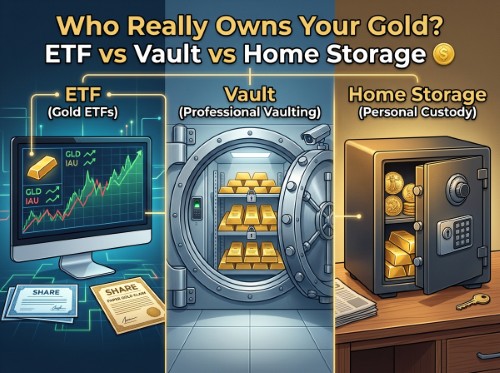
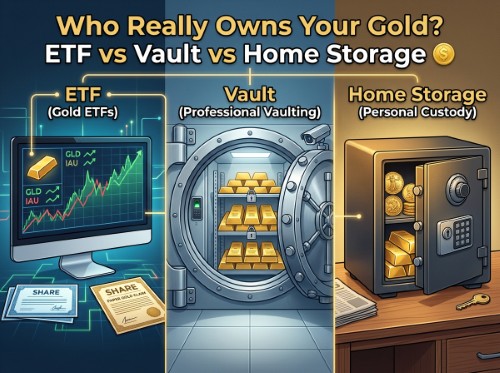
When investors decide to allocate capital into precious metals, they often spend weeks analysing market trends, spot prices, and macroeconomic signals. Yet, many overlook a decision that is just as critical to their financial security: where does the gold actually sit, and who legally owns it?
Acquiring gold is only the first half of the wealth preservation equation. The second half is choosing the custody model. Today, investors generally select one of three paths: paper Exchange-Traded Funds (ETFs), personal home safes, or independent institutional vault storage.
While each approach promises peace of mind, they operate under vastly different legal structures, cost frameworks, and risk profiles. Understanding what you gain—and quietly surrender—with each option is essential to ensuring your investment behaves the way you expect when you need it most.
For investors used to trading shares via a online brokerage, gold ETFs like SPDR Gold Shares (GLD) or iShares Gold Trust (IAU) seem like the ultimate convenience. You can gain exposure to gold prices with a single click, enjoying instant market liquidity without worrying about shipping or security locks.
However, convenience often comes at the expense of direct ownership.
When you buy a gold ETF, you do not own physical gold bars. Instead, you own shares in a corporate trust that holds gold. The legal entitlement to redeem those fund shares for actual physical bullion is strictly restricted. Under the SEC prospectus for major funds like GLD, shares can only be redeemed for physical metal by registered Authorised Participants—typically giant bank bullion desks and institutional broker-dealers—and only in massive "Baskets" of 100,000 shares at a time.
For the everyday retail investor, turning an ETF holding into physical metal delivered to your front door is virtually impossible. Your only exit strategy is selling the share back into the market for fiat currency.
Furthermore, paper gold carries ongoing custodial costs that silently erode your holding over time:
If your primary objective is short-term price speculation, an ETF is a functional tool. But if your goal is true physical asset ownership detached from the financial banking system, paper gold introduces counterparty risks that defeat the original purpose of holding precious metals.
At the opposite end of the spectrum lies home storage. Keeping gold coins or bars in a personal safe, hidden wall compartment, or floor vault offers immediate, unhindered physical control. There are no account passwords to forget, no third-party custodians involved, and zero counterparty risk. You can touch your wealth at any hour of the day or night.
For modest holdings, home storage makes intuitive sense. But as the value of a precious metal collection grows, so do the hidden financial and physical hazards.
The Insurance Fine Print
The single greatest threat to home-stored bullion is not burglary—it is under-insurance. Many investors mistakenly assume their comprehensive household contents insurance will cover their gold in the event of a break-in, house fire, or flood.
In reality, standard home insurance policies (such as the standard ISO HO-3 form widely used as an industry baseline) explicitly cap payouts for un-appraised cash, coins, and precious metal bullion at nominal amounts—often as low as £200 to £500 total.
To fully insure a substantial gold collection at home, you must obtain specialised policy riders. These require formal third-party appraisals, high-grade installed safes, continuous updates, and steep annual premiums.
Single-Point-of-Failure Risk
Storing significant wealth at home concentrates your risk into a single geographic coordinate. A single localised disaster—a house fire, a flash flood, or a targeted home invasion—can wipe out your entire physical holding in moments. Moving your metal home means you effectively take on the full-time role of an uncompensated, un-backed security guard.
Professional vault storage sits purposefully between paper ETFs and home safes. It offers the direct legal ownership of physical metal alongside institutional-grade physical protection.
Under a reputable non-bank vault storage model (such as GoldSilver’s Vault Storage program), you purchase real bullion that is directly allocated to you. The metal is housed in high-security, fully insured facilities operated by world-renowned logistics custodians like Brink’s, Loomis, or Malca-Amit across global jurisdictions.
Allocated vs. Segregated Storage
When utilising professional vaulting, investors generally choose between two operational setups:
Transparent Fees and Real Liquidity
Unlike ETF fees that quietly diminish your metal backing inside fund net asset calculations, vaulting operates on clear, explicit terms. Monthly storage fees (typically around 0.06% of total asset value per month) are billed as transparent, predictable costs.
Crucially, professional vaulting preserves high liquidity without sacrificing legal title:
Choosing the right home for your gold comes down to identifying your underlying financial priority.
The fundamental choice is not simply gold versus paper. It is deciding whether you prefer price exposure via a financial intermediary, self-custody with unmitigated personal risk, or direct title ownership inside a secure, institutional environment.
Disclaimer: This article is provided for informational purposes only, mistakes may be made, and it's not offered or intended to be used as legal, tax, investment, financial, or any other advice.