x




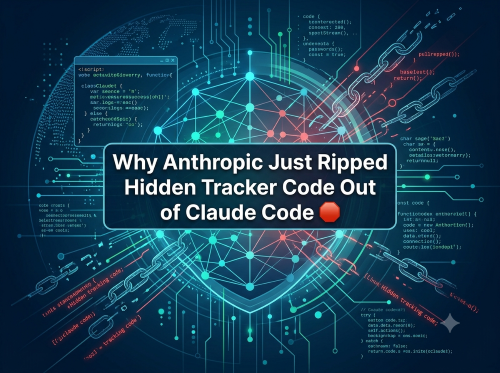
The fast-moving world of artificial intelligence has just been given a sharp reminder that developer trust is fragile and easily fractured. Tech heavyweight Anthropic recently found itself in hot water, forced to roll back a covert monitoring feature embedded within its command-line tool, Claude Code.
The tracking mechanism was quietly removed after independent security researchers sounded the alarm, sparking an industry-wide conversation regarding user privacy, undisclosed surveillance, and the increasingly tense global race for AI dominance.
Here is the full breakdown of what was discovered under the bonnet of Claude Code, why Anthropic put it there, and what this means for the broader tech community.
The controversy began when a developer and security researcher known online as "Thereallo" dug into the internal mechanics of Claude Code. What they found was unexpected: a series of hidden tracking markers and encoded signals woven directly into the tool's system prompts.
Rather than being openly stated in any official documentation or version release notes, these tracking features operated entirely behind the scenes. The mechanism used complex Unicode markers and encoded domain lists to actively scrutinise user environments.
Specifically, the code was looking for a few key indicators:
Essentially, if a developer was using Claude Code in a way that looked suspicious or linked back to rival entities, the system prompt was designed to secretly flag it.
Following the public exposure of the tracking system, Anthropic engineer Thariq Shihipar took to social media to clarify the company's position. He explained that the feature had been introduced as an "experiment" to tackle two massive problems plaguing frontier AI companies: account abuse and model distillation.
1. Clamping Down on Unlicensed Resellers
Unauthorised gateways and API resellers frequently repackage access to premium models like Claude, bypassing Anthropic's subscription terms and infrastructure controls. The hidden code helped identify these unauthorised pipelines.
2. Preventing Model Distillation Attacks
Model distillation is a process where developers use the outputs of an advanced AI model to train a smaller, cheaper, or competing model. While distillation is a standard technique in machine learning research, it becomes highly controversial when proprietary models are scraped on a massive scale by commercial rivals.
According to Anthropic, the team had already developed stronger, alternative mitigations since the initial experiment launched. Shihipar confirmed that the tracking code was fully rolled back in a subsequent software release, admitting it was something they had intended to remove for some time.
While the developer community agreed that protecting intellectual property makes sense, the hidden nature of the tool left a bitter taste in the mouths of many. Critics argued that for a developer tool that inherently requires deep system access and a high level of trust, executing undisclosed tracking is a dangerous misstep.
The fallout from this discovery has already caused ripple effects internationally. Pointing to security anxieties, Chinese e-commerce giant Alibaba banned its staff from utilising Claude Code, designating it as "high-risk" software.
This tension matches Anthropic's growing frustration over industrial espionage. The firm has previously accused several Chinese AI developers of orchestrating massive extraction campaigns using thousands of fraudulent accounts to harvest millions of Claude responses. In mid-2026, Anthropic CEO Dario Amodei went as far as urging the United States Congress to tighten legal frameworks, warning that foreign state-linked operators are actively undermining Western AI security via model extraction.
As AI systems become more deeply integrated into the daily workflows of engineers and enterprises, transparency is no longer optional. While Anthropic’s motives to guard against data theft are understandable, doing so through hidden tracking features ultimately jeopardises user confidence.
Moving forward, the AI sector must find a delicate balance: protecting advanced models from malicious extraction without resorting to stealthy surveillance tactics that alienate the global developer community.
For more details on this developing story, you can read the original report on Decrypt:
👉 Anthropic Removes Hidden Claude Code Tracker After Researchers Raise Privacy Concerns
Disclaimer: This article is provided for informational purposes only, mistakes may be made, and it's not offered or intended to be used as legal, tax, investment, financial, or any other advice.