x




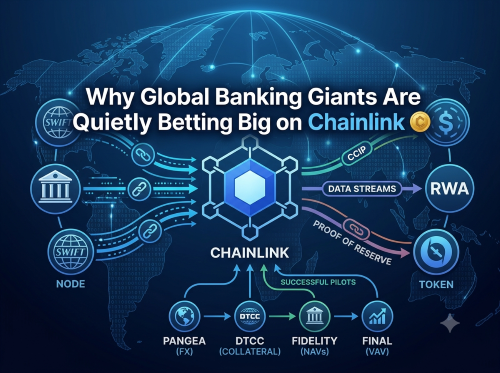
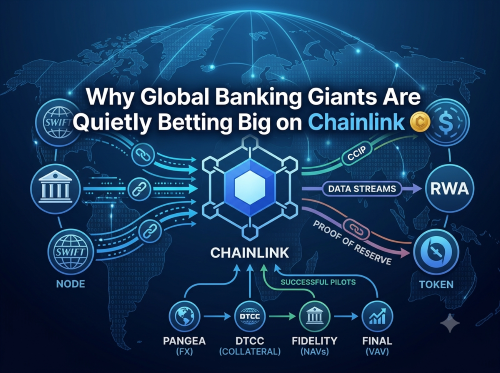
Traditional finance is undergoing a massive, silent transformation, and a single cryptocurrency network is sitting right at the centre of it. While mainstream headlines focus on the price volatility of Bitcoin and Ethereum, institutions like Swift, the DTCC, and Fidelity are quietly building their future financial plumbing on Chainlink.
Yet, despite this unprecedented institutional backing, the price of the native LINK token has remained heavily depressed, sitting down roughly 85% from its all-time high. This stark divergence presents one of the most fascinating dilemmas in the modern crypto landscape: is Wall Street building on a network destined for massive value capture, or has the market simply failed to wake up to what is being constructed behind the scenes?
To understand why traditional finance is obsessed with Chainlink, it is important to look at how the protocol has evolved. Historically, Chainlink was known simply as an "oracle"—a bridge designed to feed real-world data, such as token prices, into decentralised finance (DeFi) applications.
Today, it has transformed into a comprehensive middleware layer that connects legacy banking systems with diverse blockchain networks. For a major bank to safely interact with a blockchain, it requires three fundamental pillars:
Chainlink solves all three problems simultaneously through its Cross-Chain Interoperability Protocol (CCIP), real-time Data Streams, and Proof of Reserve (PoR) tools. This suite allows financial institutions to adopt blockchain technology seamlessly without completely ripping out their existing legacy infrastructure.
The scale of global enterprise adoption currently running on Chainlink infrastructure is immense, stretching across some of the most influential entities in global finance.
Project Pangea
Launched at the Point Zero Forum in Zurich, Project Pangea is a massive banking consortium comprising over 50 banks across approximately 16 countries. Together, these participants manage more than $10 trillion in combined assets. The objective of the project is to enable "T plus 0" atomic foreign exchange (FX) settlement using stablecoins. This initiative aims to streamline the $9.6 trillion-a-day foreign exchange market, transitioning it from a standard two-day settlement cycle to an instant, automated process. The backend of this infrastructure runs directly on Chainlink's CCIP and Data Streams.
The DTCC Collateral App Chain
The Depository Trust and Clearing Corporation (DTCC), which processes an astonishing $4.7 quadrillion in securities transactions annually, is actively developing a collateral app chain using Chainlink's infrastructure. This project targets a production launch in the final quarter of 2026, aiming to bring 24/7 automated collateral management, real-time pricing, and automated margining to the core of American financial markets.
Fidelity International’s Tokenised Fund
Fidelity International has integrated Chainlink into its tokenised money market fund, known as FITU. Chainlink programmatically publishes the fund's net asset value (NAV) directly on-chain, with daily pricing data fed in part by JPMorgan. Notably, this fund became the first tokenised liquidity fund to receive a prestigious AAA rating from Moody's at launch.
Robin Hood Chain
Launched as an Ethereum Layer 2 network, the Robin Hood Chain utilises Chainlink as its official oracle and cross-chain provider. It powers tokenised stocks for major companies like Nvidia, Google, and Apple, specifically citing Chainlink's institutional-grade security as the reason for its selection.
For long-term holders of the LINK token, the primary source of frustration is clear: if adoption is booming, why is the token price lagging?
Holding LINK does not grant a direct dividend from network fees; instead, fees primarily flow to the node operators who secure the network. Therefore, the long-term investment thesis relies heavily on two structural mechanisms:
While CCIP fee revenue and transfer volumes have experienced massive triple-digit quarter-on-quarter growth, these fee sums are still relatively modest compared to the circulating supply of 730 to 750 million tokens. Sceptics point to a potential "pilot problem," drawing comparisons to projects like Ripple (XRP), where massive enterprise partnerships took years to translate into direct token demand.
Whether Chainlink proves to be the ultimate asymmetric bet in crypto depends heavily on several key milestones over the coming months:
With global banking giants deeply committed to building on this infrastructure, the underlying network is rapidly expanding. If these high-profile pilots transition successfully into full production volume, the gap between institutional adoption and token value could begin to close rapidly.
Coin Bureau - Why BIG BANKS Are Betting On Chainlink
"Chainlink is now the crypto network of choice for over 50 of the world’s largest banks, DTCC, and Robinhood, moving trillions in value. But with LINK still far below previous highs, the big question is: does any of this adoption actually matter for the token?
This video unpacks the real deals, actual integrations, data on network growth, and the ongoing controversy about token flows, reserves, and staking. Get the full story before making your next move with Chainlink."
~ TIMESTAMPS ~
0:00 – Why Wall Street Picked Chainlink
2:25 – The 3 Core Tech Pillars Powering the Network
4:52 – Inside the Huge Institutional Integrations
7:18 – Expanding into World Cup Prediction Markets
9:45 – Does Adoption Actually Drive Value to the Token?
12:12 – The Staking and Economic Mechanics Explained
14:38 – Addressing Dilution and the Pilot Project Concerns
17:05 – Key Future Signals Every Holder Needs to Watch
Source 👉 www.youtube.com/watch?v=LDda79aVd-E
Disclaimer: This article is provided for informational purposes only, mistakes may be made, and it's not offered or intended to be used as legal, tax, investment, financial, or any other advice.