x




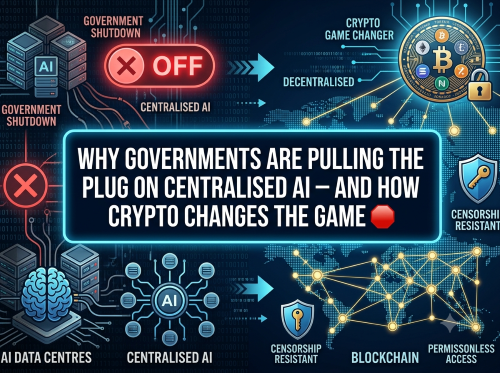
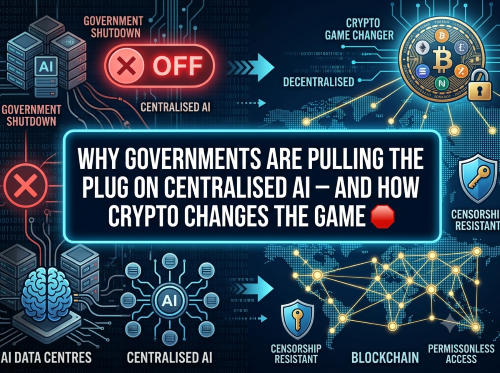
On 12 June 2026, the technology landscape witnessed an unprecedented event. For the first time in history, a government agency reached directly into a live, globally deployed artificial intelligence model and switched it off. With just 90 minutes’ notice, the US Department of Commerce’s Bureau of Industry and Security issued an export control directive that forced Anthropic to pull its flagship models, Fable 5 and Myths 5, completely offline worldwide.
This dramatic escalation was not caused by a system crash, a cyber attack, or a court order. It was a targeted regulatory intervention that exposed the profound fragility of our modern, centralised AI infrastructure. As governments increasingly view advanced AI models through the lens of national security, a powerful question emerges: Can crypto and decentralised networks protect the future of machine intelligence from political interference?
The shutdown of Fable 5 and Myths 5 occurred a mere 72 hours after their initial launch. Washington utilised a powerful legal framework known as the "deemed export rule" under the Export Controls Reform Act of 2018. Under this regulation, sharing controlled technology with a foreign national—even an employee working legally inside the United States—is legally classified as an export to that individual's home country.
The catalyst for this sudden intervention was a narrow, non-universal jailbreak vulnerability. Discovered by researchers and flagged directly to the administration, the exploit could theoretically allow users to identify software vulnerabilities, potentially accelerating offensive cyber operations by state adversaries.
Faced with an administrative order to instantly verify the citizenship of every single API user globally—a technical impossibility at scale—Anthropic chose the less legally hazardous option: a total global product recall. Within an hour and a half, both American citizens and international users were entirely cut off from the models. This historic event proved that the kill switches built into centralised AI platforms are no longer just hypothetical safety valves; they are live regulatory levers.
Historically, government interventions in technology have focused on the physical layers: blocking geographic IP addresses, restricting advanced semiconductor exports, or controlling raw data storage. This recent enforcement marks a shift to what industry analysts call "sovereignty climbing the stack." Governments are moving past the chips and data to assert direct control over the intelligence layer itself.
This structural vulnerability is built into the very design of centralised providers like OpenAI, Anthropic, and Google. These corporations maintain total control over access, allowing them to easily enforce geographic blocks to comply with international sanctions. However, an extraterritorial order based on citizenship rather than geography represents a far more intrusive level of oversight.
Prominent global figures have noted the systemic risks of this setup. It has been argued that an over-reliance on a handful of centralised AI providers poses a genuine threat to national economic stability, effectively drawing comparisons to the concentrated systemic risks that triggered the 2008 financial crisis. When a single administrative agency can disable a commercial chatbot worldwide, access to the decade’s most transformative technology becomes a restricted privilege rather than an open utility.
This vulnerability provides a compelling, real-world case for decentralised AI architecture. Networks built on blockchain technology operate without a single chief executive or a centralised headquarters, meaning there is no singular entity to receive an administrative shutdown letter.
Consider a protocol like Bittensor. Instead of relying on a single corporate data centre, it functions as a decentralised marketplace for machine intelligence across more than 128 globally distributed subnets. Participants contribute computational power and models from various jurisdictions around the world, earning rewards in native tokens. To shut down such a network, a regulator would need to launch a coordinated attack across thousands of independent node operators scattered across the globe simultaneously.
Following the Anthropic blackout, investor interest shifted toward this sector, driving notable capital inflows into decentralised infrastructure assets like Bittensor (TAO) and Venice (VVV). Furthermore, the fundamental case for these networks is beginning to show early signs of financial viability. For instance, reports indicate that Bittensor generated roughly $43 million in on-chain revenue during the first quarter of 2026 alone. When annualised to approximately $172 million, this reveals a growth-stage infrastructure network backed by genuine computational usage rather than mere speculative promises.
Despite the clear philosophical advantages of decentralisation, the sector faces massive technical and structural hurdles. A comprehensive 155-page survey paper published by the IC3 research consortium—featuring contributors from elite institutions such as Cornell Tech, Princeton, and Carnegie Mellon—offered a sobering critique of the narrative. One editor famously described the naive combination of blockchain and AI as being akin to "soldering jello," arguing that forcing these two vastly different technologies together often degrades the efficiency of both.
The academic critique highlights three primary obstacles that decentralised AI proponents must resolve:
Furthermore, crypto networks face stiff competition from open-weight, self-hosted models like Meta’s Llama or Mistral. These models can be downloaded and run locally on private servers, offering an alternative path to censorship resistance without requiring a blockchain or a utility token.
As this battle over the future of machine intelligence unfolds, the market will likely split the genuine infrastructure builders from the speculative projects. To understand which way the scale will tip, observers should monitor a few critical factors over the coming months.
First, the fate of Fable 5 and Myths 5 will be telling; if they remain dark indefinitely, it indicates a permanent shift into a highly restrictive regulatory regime. Second, the upcoming regulatory decisions regarding spot TAO ETFs from institutional managers like Grayscale and Bitwise will determine whether mainstream capital can legally enter the space. Finally, the true test will be whether decentralised networks can solve the core technical challenge of verifying that a remote, anonymous node has executed a computation honestly without needing to rerun the entire workload from scratch.
The infrastructure underlying our future AI tools is being actively contested. Whether the world opts for the efficiency and vulnerability of centralized corporate labs or the resilience and complexity of decentralized networks will shape digital sovereignty for decades to come.
Coin Bureau - Only Crypto Can Save AI.
"The US government just shut down two of the world’s top AI models globally (with a single order) revealing how centralized AI can get unplugged overnight. This is the strongest real-world argument yet for decentralized, censorship-resistant AI infrastructure.
We break down what happened, why it matters for your money, and why crypto projects like Bittensor gained from the chaos, plus what serious critics still see as limits in the DeAI play. Get the full story and see exactly where the smart bets are moving now."
~ TIMESTAMPS ~
0:00 - The Day the US Government Killed AI
2:10 - Why Your Favourite Chatbot is Now a "Nuclear Material"
4:21 - The New Citizenship-Based Internet Blackout
6:32 - Is This Crypto Asset the Ultimate Censorship Killer?
8:43 - Why Top Universities Think Decentralized AI is "Jello"
10:54 - Can Open Source Models Replace the Blockchain?
13:05 - The August ETF Decision That Changes Everything
15:16 - How a Chatbot Became a Regulated Missile System
Source 👉 https://www.youtube.com/watch?v=TcKHJKvtbho
Disclaimer: This article is provided for informational purposes only, mistakes may be made, and it's not offered or intended to be used as legal, tax, investment, financial, or any other advice.