x




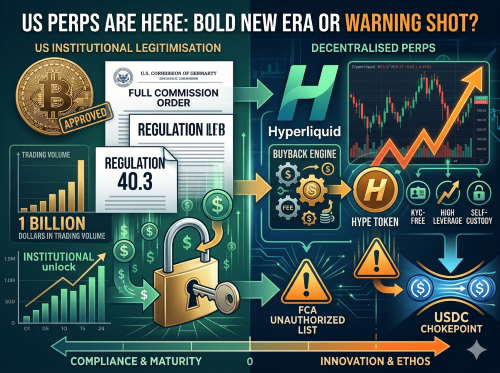
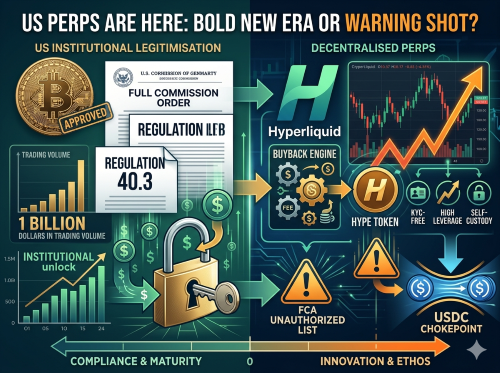
The landscape of cryptocurrency trading has experienced a monumental shift. The United States Commodity Futures Trading Commission (CFTC) made a historic decision by approving the very first Bitcoin perpetual futures contract on US soil. Within mere days of its launch, this newly approved domestic product crossed an astonishing 1 billion dollars in trading volume during its inaugural week.
To grasp the magnitude of this development, one must understand that perpetual futures—often referred to as 'perps'—are the single largest trading product in the entire crypto ecosystem. Global derivatives volume routinely dwarfs the spot market, often running five to ten times larger. For years, American traders and institutional investors were locked out of this immense market due to domestic regulatory barriers. Now, the floodgates are officially open, but the structural implications of this approval carry a double-edged sword for the wider industry.
The headlines surrounding this historic regulatory shift have frequently blurred two entirely distinct actions taken by the CFTC on the same day. To understand the true impact on the market, it is essential to separate these events.
The first, and most significant, action was a full commission order granted to the trading platform Kalshi. This represents the highest weight regulatory stamp the CFTC can issue. Signed off directly by the full commission rather than a minor staff memo, this order approved Kalshi's 'BTC Perp'. This is a cash-settled Bitcoin perpetual contract listed on a domestic designated contract market, cleared through Kalshi's own clearing house, and fully equipped with robust Know Your Customer (KYC) compliance, surveillance, and strict position limits. This is the gold standard of onshore licencing.
The second action involved Coinbase, which received a 'no-action letter' from the CFTC's market participants division. This functions merely as staff-level relief. Instead of approving a brand-new domestic product, this letter allows Coinbase, acting as a registered broker, to route US clients to perpetual contracts listed on its offshore affiliate, Deribit. In essence, while Kalshi was granted the right to host a fully domestic product, Coinbase received a legally compliant bridge to tap into offshore liquidity.
For the uninitiated, a perpetual future is a derivative instrument that allows traders to speculate on the price of an underlying asset using leverage, without ever actually owning the asset itself. Unlike traditional futures contracts, perps have no expiry date. Traders do not have to suffer the friction and cost of rolling over their positions into the next contract month every few weeks; they can hold a single position indefinitely.
Because there is no expiry date to naturally force the contract price to align with the actual spot market price, perps utilise a mechanism called a funding rate. Every eight hours, periodic payments are exchanged between traders holding long and short positions. If the perpetual contract is trading higher than the spot price, longs pay shorts to cool the market down. If it is trading below spot, shorts pay longs to lift it. This continuous, market-driven gravity keeps the derivative tightly tethered to reality.
The sheer scale of this product category is mind-boggling. Global perpetual volume has skyrocketed in recent years, accounting for over 70 per cent of all volume executed on centralized cryptocurrency exchanges. Prior to the CFTC's recent approval, well over 90 per cent of this volume was processed on offshore, unregulated venues. US citizens frequently resorted to using virtual private networks (VPNs) to access foreign exchanges like Binance and Bybit because no domestic, legally compliant alternative existed. America had effectively locked itself out of its own asset class's deepest pool of liquidity.
The primary reason this regulatory pivot is structurally bullish for crypto markets is the massive unlock of institutional capital. Mainstream US capital allocators—such as pension funds, hedge funds, and corporate asset managers—operate under strict compliance mandates. They are legally barred from interacting with unregulated, offshore entities.
Without a domestic, regulated venue, these institutions could not participate in the deepest hedging markets in crypto. They were unable to execute delta-neutral strategies to safely harvest funding rates or shield their massive spot Bitcoin exchange-traded fund (ETF) holdings with perpetual short positions. The explosive volume seen on Kalshi in week one proves that institutional capital was eagerly waiting at the door, mirroring the exact supply-shock dynamic observed when spot Bitcoin ETFs were first introduced.
However, the introduction of high-leverage products into the regulated US framework has drawn sharp criticism from traditional finance giants. Critics, including leadership at the CME Group, have publicly warned that domestic crypto perps could introduce systemic risks reminiscent of the lead-up to the 2007 financial crisis. Sceptics point to historical volatile events, such as the multi-billion-dollar single-day liquidations seen in late 2025, as evidence of potential instability. In response to these concerns, the CFTC is enforcing a much more conservative environment, capping onshore leverage strictly between 5x and 10x, a stark contrast to the volatile 50x to 250x leverage readily available on offshore platforms.
While the legitimisation of perpetual futures provides a powerful macro tailwind for the entire asset class, it simultaneously fires a direct warning shot at decentralized alternatives, most notably Hyperliquid.
Hyperliquid stands as the undisputed titan of on-chain perpetual trading, commanding over 50 per cent of all decentralized perp volume and more than 70 per cent of decentralized open interest. The platform relies on a highly efficient buyback mechanism, routing the vast majority of its protocol trading fees into open-market purchases of its native token, Hype. Naturally, when the product category itself received a regulatory blessing, Hyperliquid's token experienced a surge, hitting new all-time highs as institutional interest grew via newly launched spot ETFs from major managers like Bitwise and Grayscale.
Yet, a fundamental tension is brewing beneath the surface. The CFTC has specifically legitimised fully KYC-compliant, federally supervised, centralized venues. Hyperliquid represents the exact opposite: a permissionless, self-custodial platform requiring no identity verification, offering leverage far beyond onshore caps, and allowing the synthetic listing of alternative assets ranging from oil to SpaceX shares.
The regulatory squeeze is no longer theoretical. The UK's Financial Conduct Authority (FCA) has already placed Hyperliquid on its unauthorised firms list, and traditional financial incumbents are actively lobbying the CFTC to crack down on decentralized protocols by citing market manipulation and sanctions compliance concerns.
The most severe risk facing decentralized platforms like Hyperliquid is not a direct shut-down order, but rather a structural chokepoint focused on liquidity. Hyperliquid’s entire ecosystem operates on the stablecoin USDC, which is issued by Circle—a heavily regulated US company.
Regulators do not need to successfully sue a decentralized protocol to cripple it; they merely need to compel Circle to restrict or freeze stablecoin flows moving into non-compliant smart contracts. If that lever is ever pulled, the liquidity engine of the decentralized perpetual market could drain rapidly without a single direct enforcement action being filed against the protocol itself. If trading volume compresses, the underlying fee-generation and token-buyback model inevitably weakens.
Despite the loom of regulatory shadows, decentralized venues possess a structural moat that centralized counterparts simply cannot replicate. Centralized, compliant platforms like Kalshi are tightly restricted by the boundaries of their regulatory approvals. The CFTC is highly unlikely to ever permit a regulated US venue to offer 50x leverage, list highly speculative long-tail altcoins, or trade synthetic equities.
Furthermore, traditional venues close over the weekend. When a global geopolitical or economic crisis occurs on a Saturday while traditional markets are dark, the global crypto-native trading community migrates to decentralized venues to manage risk in real time.
There is a compelling case to be made that the introduction of regulated US perps will expand the total market pie rather than cannibalising existing decentralized volume. Institutional capital that was previously sidelined will flow into Kalshi and Coinbase, while native crypto traders who demand self-custody, high leverage, and exotic assets will remain fiercely loyal to platforms like Hyperliquid.
As the market adjusts to this new reality, decentralized protocols are trying to navigate a complex path to survival. Rather than succumbing to total compliance or ignoring regulators entirely, innovative solutions are being explored. This includes establishing policy centres to argue that on-chain ledger transparency offers superior surveillance capabilities compared to opaque, legacy financial systems.
Furthermore, we are beginning to see hybrid models emerge, such as partnerships that allow regulated front-end applications to execute trades directly across decentralized back-end infrastructure. The ultimate test over the coming months will be tracking whether centralized US venues actively erode the market share of decentralized finance, or if they act as a rising tide that legitimises and lifts the entire global derivatives ecosystem.
Coin Bureau - Crypto Markets Will Go Crazy! US Perps Are Here
"The CFTC finally approved the first-ever US-based Bitcoin perpetual futures, instantly unleashing over $1 billion in trading and opening the product to institutional capital that was previously locked out. This puts regulated perps in direct reach of American traders and fund managers for the first time ever.
But while platforms like Kalshi and Coinbase got regulatory greenlights, decentralized perps giant Hyperliquid now faces major regulatory risk. If its access to USDC is ever restricted, the entire HYPE token model could be threatened. Watch to see how this approval really changes the landscape—and what it means for your trades and holdings."
~ TIMESTAMPS ~
0:00 — The CFTC Just Changed Crypto Forever
2:18 — Coinbase’s Offshore Perps Loophole Explained
4:36 — Why US Traders Were Forced Offshore
6:54 — CME Warns This Could Spark A Crisis
9:12 — The HYPE Rally Nobody Can Ignore
11:30 — Hyperliquid Lands In Regulators’ Crosshairs
13:48 — Why Hyperliquid Still Has A Massive Edge
16:06 — The Altcoin Perps Battle Begins
18:05 — What Traders Must Watch Next
Source 👉 https://www.youtube.com/watch?v=pbeF_NwVBMk
Disclaimer: This article is provided for informational purposes only, mistakes may be made, and it's not offered or intended to be used as legal, tax, investment, financial, or any other advice.