x



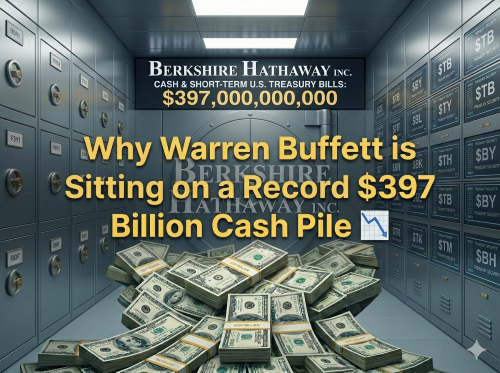
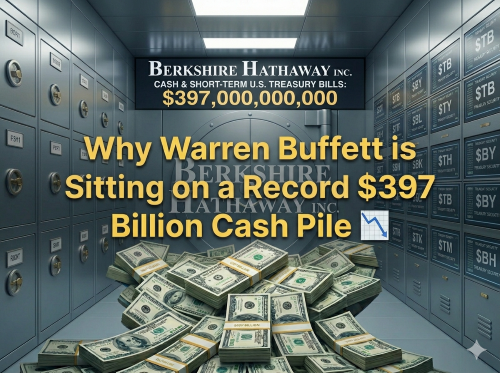
The financial world is buzzing with a single question: Why is Warren Buffett, the "Oracle of Omaha" and the most respected long-term investor in modern history, sitting on a staggering $397 billion in cash? This isn't just a large sum of money; it is a historic war chest that represents the largest cash and short-term treasury position Berkshire Hathaway has ever assembled in its 60-year history. To put the scale into perspective, this pile is larger than the GDP of Norway and greater than the market capitalisation of almost every public company on Earth.
This massive accumulation of capital didn't happen by accident or overnight. Throughout 2024 and 2025, Berkshire Hathaway methodically dismantled some of its largest and most iconic equity positions. Buffett has been a net seller of stocks for roughly 12 consecutive quarters. Two of the most significant moves included slashing Berkshire's stake in Apple by approximately 75% and cutting its position in Bank of America by half.
Rather than reinvesting these billions back into the stock market, the proceeds have been parked almost entirely in short-duration U.S. Treasury bills. In today’s interest rate environment, this "do-nothing" strategy is actually quite lucrative, generating roughly $12 billion to $13 billion a year in interest for the company.
Buffett has positioned Berkshire this defensively only twice before in his legendary career. The first instance was just before the dot-com collapse in 1999, and the second was leading up to the global financial crisis in 2008. On both occasions, the financial press mocked him for being "out of touch" or "missing the boat" as markets surged. However, in both instances, he was vindicated within 18 months when market bubbles burst, leaving him with the liquidity needed to buy high-quality assets at deep discounts.
The current build-up suggests that Buffett is reading the same signals he saw decades ago. His preferred valuation gauge, often called the "Buffett Indicator" (the ratio of total U.S. market capitalisation to GDP), is currently at 232%. This is the highest reading ever recorded, even eclipsing the levels seen during the dot-com peak, which Buffett famously described as "playing with fire."
The primary reason for the record cash pile is simple: Buffett cannot find anything to buy at prices that satisfy his strict return requirements. With the S&P 500 hovering near all-time highs and sectors like technology trading at price-to-earnings multiples that double their historical averages, the market is arguably more expensive than it has ever been.
Even Berkshire Hathaway’s own stock isn't immune to this scrutiny. Buffett halted share buybacks for five consecutive quarters, a clear signal that he views his own company's shares as modestly overvalued. When a disciplined capital allocator refuses to buy his own stock or the broader market, it sends a powerful message about the current state of valuations.
In the Buffett playbook, cash is not just a defensive shield; it is an offensive weapon. By holding nearly $400 billion, Berkshire is prepared to act as the "lender of last resort" during the next major market dislocation. History shows that during times of crisis—like the 2008 collapse of Lehman Brothers—Buffett is able to extract incredibly favourable terms because he is the only one with the cash to write the check.
Whether it’s taking controlling positions in major companies or funding massive private credit deals, this mountain of cash gives Berkshire the optionality to absorb forced selling across any asset class.
A crucial difference in today’s landscape compared to the last decade is that cash no longer acts as "dead weight" on a portfolio. During the era of zero percent interest rates, holding cash meant losing out on potential returns. Today, with Treasury yields in the high 3% range, Berkshire earns more in interest income than most S&P 500 companies produce in total revenue.
This structural shift means the bar for finding a compelling investment has risen. Buffett doesn't necessarily need to predict a crash to justify holding cash; he simply needs to believe that the future returns of overvalued stocks won't outperform the safe, guaranteed yield of government bonds. For investors everywhere, the signal is clear: caution, patience, and liquidity may be the most valuable assets in the coming cycle.
Coin Bureau - The Terrifying Reason Warren Buffett Quietly Sold EVERYTHING
"Warren Buffett is sitting on $397 billion in cash, the biggest defensive move of his career. What does he know that you don't? In this video, we uncover why the world's most famous investor is selling out of stocks and building up a war chest bigger than most countries' economies.
This affects every investor, from stocks to crypto. Discover Buffett’s hidden signals, why he’s acting now, and what it could mean for your money if history repeats. If you care about protecting your future, you can’t afford to miss this breakdown."
~ TIMESTAMPS ~
0:00 Warren Buffett’s $397B Cash Warning
2:05 Berkshire Sells Apple & Bank of America Stock
4:00 Buffett’s Dotcom Crash & 2008 Crisis Signals
6:05 Buffett Indicator Hits Record Market Valuation
10:20 Why Cash Is Now Earning Serious Returns
Source 👉 https://www.youtube.com/watch?v=W6bAF_02TPs
Disclaimer: This article is provided for informational purposes only, mistakes may be made, and it's not offered or intended to be used as legal, tax, investment, financial, or any other advice.