x




Over the past few years, discussions surrounding artificial intelligence (AI) security have focused heavily on the model itself. Security researchers and business leaders alike have spent countless hours asking the same core questions: Is the large language model (LLM) properly aligned? Can it be jailbroken? Does it hallucinate under high-pressure queries?
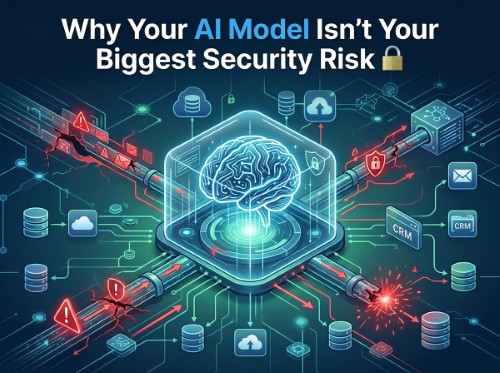
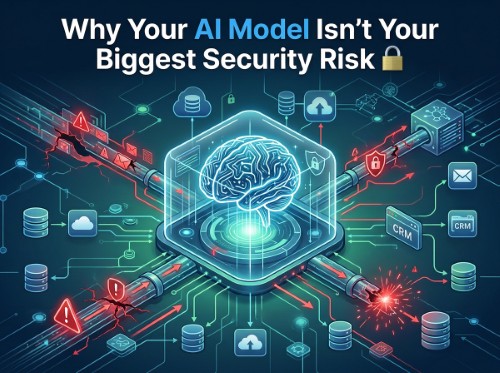
While these concerns are undeniably valid, a far more insidious category of risk is emerging as enterprises transition from static AI chatbots to fully autonomous agentic workflows. Surprisingly, this new threat vector has almost nothing to do with the model's underlying neural weights or training datasets. Instead, it resides entirely within the software architecture and system integration built around the model.
In short, the model is rarely the main point of failure—the workflow is.
For a long time, standard enterprise AI security models rested on a relatively straightforward interaction pattern. A human user typed a prompt into a text box, the language model generated a response, and the human evaluated the output before deciding whether to act on it. Human judgment served as a natural firewall.
However, that paradigm is now largely obsolete. Modern AI workflows are no longer restricted to passive conversations. Production-grade AI agents are active participants in enterprise ecosystems. They read live feeds from customer relationship management (CRM) systems, pull information from internal documentation, call external application programming interfaces (APIs), write to live databases, and trigger complex downstream automations. In an increasing number of environments, these operations occur entirely without human oversight.
While these capabilities unlock incredible efficiency gains, they simultaneously create an expansive attack surface that simply did not exist during the early chatbot era. The fundamental issue is a growing gap between the untrusted data AI agents read and the powerful production systems they are authorised to modify.
Securing autonomous workflows requires understanding how vulnerability emerges when probabilistic models are granted direct system access. Five major architectural vulnerabilities are currently defining this landscape:
1. Indirect Prompt Injection via Connected Data
In traditional web application security, user input is treated with strict suspicion. However, an AI agent treats ingested content as contextual instructions. When an agent retrieves data from a CRM ticket, a shared cloud document, an email signature, or a scraped web page, that content becomes part of its cognitive context.
An attacker does not need direct access to your AI model to alter its behaviour. They only need to plant malicious instructions inside a document or email that the agent will inevitably read. A hidden command within an attached invoice or customer ticket can hijack the agent's decision-making process, instructing it to exfiltrate data or perform unauthorised system updates.
2. Over-Permissioned Tool Execution
During rapid development cycles, AI tools are frequently integrated using overly broad API keys or high-privilege service accounts. Engineers often grant full administrative access to accelerate testing, promising to restrict permissions later.
When these over-permissioned configurations reach production, the consequences of a single logic error or prompt manipulation compound instantly. If an AI agent possesses full write or delete access across a database, a single misinterpreted prompt can result in erased records, misrouted payments, or confidential notifications being broadcast to external lists.
3. Fragile Trust Boundaries Between Multi-Agent Pipelines
Modern enterprise architectures increasingly rely on multi-agent systems, where specialised AI agents pass data sequentially to one another. Unfortunately, these pipelines often lack boundary validation between stages.
For instance, if an initial agent reads and summarises an unverified external document, and then passes that summary to a secondary agent equipped with database write permissions, a trust boundary has been breached. The secondary agent executes actions based on untrusted third-party content without re-verifying the input, effectively granting an unauthenticated external actor direct influence over internal operations.
4. The Observability and Auditability Gap
Traditional cybersecurity relies on deterministic logging. Security operations teams trace request logs, track call stacks, and reconstruct event timelines following an incident.
Agentic workflows complicate this paradigm significantly. Because LLM reasoning traces are non-deterministic, two runs given the same input may yield completely different sequences of tool calls. Furthermore, many organisations fail to log intermediate reasoning steps, prompt contexts, and argument parameters used during execution. When an anomaly occurs, incident response teams are left guessing how and why the AI reached a specific decision.
5. Automated Execution Without Circuit Breakers
As companies strive for full automation, AI agents are increasingly entrusted with end-to-end execution. Rather than drafting an email or flagging a financial anomaly for human review, the agent executes the action autonomously.
Without strict rate limits, approval thresholds, or manual kill switches, a faulty reasoning loop can trigger hundreds or thousands of incorrect actions in a fraction of a second. The financial and reputational cost of such failures multiplies before human operators even realise an error has occurred.
Much of the vulnerability surrounding AI agent workflows stems from an organisational misalignment. In many enterprises, AI security responsibilities fall exclusively on machine learning or data science teams. While these specialists are equipped to evaluate model accuracy, hallucination rates, and fine-tuning procedures, they may lack deep background in enterprise integration security, network segmentation, and identity and access management.
Conversely, security and platform engineering teams—who possess decades of experience enforcing least-privilege access, auditing service-to-service communication, and building robust logging systems—are often excluded from the AI implementation process until workflows are already live in production.
To bridge this gap, organisations must treat AI agents not as novel black-box experiments, but as standard production microservices that happen to incorporate a probabilistic decision engine.
Securing the ecosystem around your AI models does not require reinventing cybersecurity fundamentals. Instead, it demands applying proven engineering discipline to non-deterministic systems. Leading security teams are implementing the following practical guardrails:
Upgrading to a newer, more sophisticated large language model will not fix an over-permissioned database connection. Elevating model safety metrics will not replace a missing human approval gate.
As autonomous AI agents assume greater responsibility across enterprise IT ecosystems, the primary determinant of security will not be the intelligence of the model, but the resilience of the architecture built around it. Organisations that proactively apply sound software governance, strict access controls, and detailed observability to their agentic workflows will successfully harness the power of AI while keeping their critical systems protected.
Disclaimer: This article is provided for informational purposes only, mistakes may be made, and it's not offered or intended to be used as legal, tax, investment, financial, or any other advice.