x




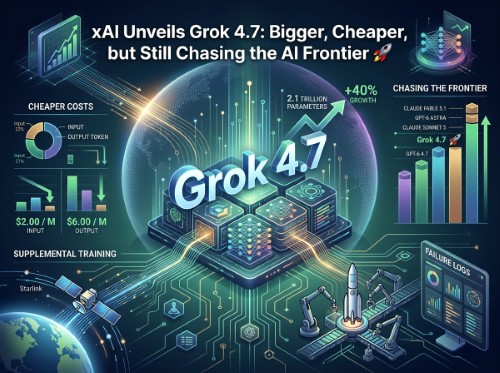
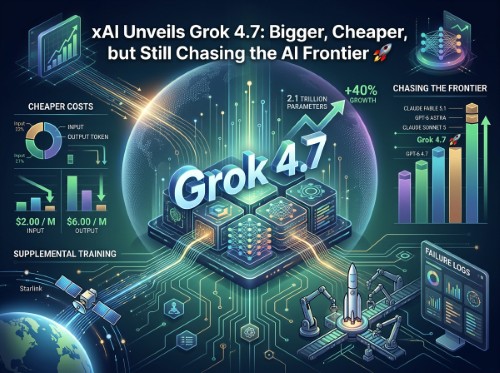
Elon Musk’s artificial intelligence startup, xAI, has officially released its latest flagship model, Grok 4.7. Arriving after a string of high-profile delays that stretched back to late July, the new model represents a substantial technical upgrade over its predecessor, Grok 4.6. Featuring a massive expansion in parameter scale and specialised supplemental training, Grok 4.7 enters an increasingly competitive landscape.
However, while xAI promises a notable leap in reasoning capacity and hardware understanding at the same price point, third-party benchmarks highlight a familiar narrative: xAI continues to produce formidable models that sit just a step behind the top spot on the frontier leaderboard.
The launch of Grok 4.7 follows months of anticipation and shifting release windows. Musk had publicly walked back the model's timeline at least five times since mid-summer, moving the target from "four weeks out" to "a few weeks", then "10 days", and finally declaring in early September that it needed "a few more days to cook".
Now officially live, Grok 4.7 has been deployed without a waitlist. It is accessible immediately across the Grok standalone app, the developer-focused Grok Build platform, the xAI API, and the Cursor coding environment. Additionally, it powers everyday consumer interactions across X (formerly Twitter) and within Tesla vehicle dashboards.
Described by Musk as a "strong combination of intelligence, speed, and low cost", the updated architecture focusses heavily on deliberative reasoning. The model spends significantly longer working through complex, multi-layered queries and incorporates internal self-checking mechanisms to reduce hallucination rates, accompanied by what xAI describes as its most robust safety guardrails to date.
From a technical perspective, Grok 4.7 represents a major scaling effort. The model boasts an impressive 2.1 trillion parameters—a 40% increase over the 1.5 trillion parameters found in Grok 4.6. In deep learning, parameters dictate a network's capacity to recognise intricate patterns and generalise across disparate domains.
What sets Grok 4.7 apart from many of its peers is its unique training curriculum. Alongside standard web-scale text corpora, xAI ingested an extensive array of proprietary engineering data from SpaceX. This dataset included:
By anchoring part of its training in real-world physics, telemetry, and hardware design, xAI aims to give Grok 4.7 a distinctive edge when reasoning about physical systems, mechanical engineering, and complex hardware troubleshooting.
Despite its parameter expansion and unique dataset, independent evaluations indicate that Grok 4.7 remains a silver medallist across key industry benchmarks.
While trailing slightly behind Anthropic and OpenAI on frontier leaderboards might seem like a setback, xAI's broader market strategy relies on a different value proposition: cost efficiency and ubiquity.
Grok 4.7 maintains an aggressive pricing structure of $2.00 per million input tokens and $6.00 per million output tokens. By keeping inference costs low while expanding model parameter capacity, xAI is positioning Grok as a highly economical alternative for enterprise workflows, automated voice assistants, and high-volume API requests.
For the vast majority of end-users—whether asking questions on X, adjusting vehicle controls via Tesla's voice assistant, or drafting daily code—the distinction between first and second place on an Elo chart is rarely noticeable. xAI’s gamble relies on the belief that a model that is "exceptionally capable, cost-effective, and deeply integrated" will capture market share regardless of top-spot ranking.
Musk himself managed expectations shortly before launch, noting that Grok 4.7 was designed to align roughly with Anthropic's Claude Opus 5.0 rather than surpassing the absolute cutting edge, acknowledging that multimodal capabilities still require further refinement.
However, xAI is already looking toward its next development cycles. Musk outlined a multi-stage roadmap for the coming generations:
Though concrete release dates for future iterations remain unconfirmed, Grok 4.7 demonstrates that xAI remains an agile, heavily resourced contender in the ongoing battle for artificial intelligence infrastructure.
Disclaimer: This article is provided for informational purposes only, mistakes may be made, and it's not offered or intended to be used as legal, tax, investment, financial, or any other advice.