x




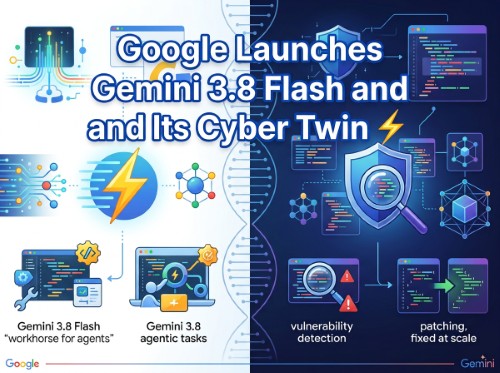
In a remarkable display of rapid iteration, Google has unveiled two distinct variants of its latest light-footprint artificial intelligence model: Gemini 3.8 Flash and Gemini 3.8 Flash Cyber. Marking the tech giant's third Flash release in a mere six weeks, this update addresses two of the most pressing demands in modern enterprise computing: high-diligence autonomous AI agents and proactive, automated cybersecurity defence.
By splitting the release into a versatile enterprise workhorse and a specialised security twin, Google is providing organisations with powerful tools tailored specifically for execution speed, multi-step reasoning, and complex vulnerability management.
Gemini 3.8 Flash has been engineered from the ground up to handle multi-step reasoning, agentic workflows, and complex software development. While previous generations focused heavily on sheer speed and token reduction, 3.8 Flash introduces a fundamental shift in philosophy: working harder and exhibiting greater diligence when faced with complex multi-step prompts.
Flexible Performance and Cost Efficiency
Google has maintained a highly competitive pricing structure for Gemini 3.8 Flash, matching the introductory rate of its predecessor at $0.75 per million input tokens and $3.75 per million output tokens. Crucially, developers are given direct control over model effort levels. When compute efficiency is paramount, token overhead can be dialled down; conversely, when tackling intricate engineering problems, the model can consume additional tokens to reason through solutions thoroughly.
Key technical capabilities include:
Benchmark Supremacy and Real-World Applications
Across rigorous industry evaluations, Gemini 3.8 Flash has demonstrated significant leaps in capability over Gemini 3.7 Flash and competing frontier models. On the DeepSWE coding benchmark, it delivered exceptional performance at a fraction of the operational cost. In global leaderboards such as Arena.ai, Gemini 3.8 Flash rocketed to 14th position on the Agent Arena (comfortably outpacing DeepSeek-V4-Pro) and landed at 7th on the Text Arena, ahead of Claude Opus 5.
It has also established strong leads in specialised domain knowledge, outperforming competitors on Harvey's Legal Agent Benchmark, the Vals Finance Agent V2 benchmark, and achieving 54.9% on the verified Humanity’s Last Exam (HLE) evaluation.
To illustrate these capabilities, Google demonstrated several practical projects built natively by the model:
While standard Flash empowers agentic creation, Gemini 3.8 Flash Cyber was built to defend software ecosystems against an increasingly hostile digital landscape. According to Doug Turner, Engineering Director for Chrome, the proliferation of generative AI tools has triggered a "vulnerability apocalypse," leading to an exponential surge in reported software bugs and potential security exploits.
Because malicious threat actors can use automated tools to hunt for single flaws across millions of lines of code, enterprise defenders require equivalent AI capabilities to find, analyse, and patch vulnerabilities before they can be exploited.
Prioritising Automated Defence and Patch Generation
Unlike models trained broadly across offensive techniques, Gemini 3.8 Flash Cyber has been heavily fine-tuned specifically for vulnerability discovery and automated patch generation. During internal benchmark tests across 20 programming languages, the security model achieved a discovery success rate exceeding 70%. Additionally, it scored 86.2% on the CyberGym benchmark and 47.2% on CWE-Bench for automated code patching.
The model’s real-world efficacy was highlighted by several startling achievements during internal testing:
Responsible Rollout via the Fairwind Program
Recognising that security-focused AI models possess advanced code manipulation capabilities, Google is restricting initial access to trusted entities through its Fairwind Program. This initiative prioritises government authorities, critical infrastructure operators, and key enterprise defence partners.
By shipping the model with robust safeguards against chemical, biological, radiological, and nuclear (CBRN) risks as well as prompt injection attacks, Google aims to ensure that high-speed, automated vulnerability management remains firmly in the hands of legitimate defenders.
The simultaneous release of Gemini 3.8 Flash and Gemini 3.8 Flash Cyber signals a mature shift in enterprise AI development. Rather than relying solely on monolithic, high-latency models, Google is proving that compact, highly diligent models optimised for targeted tasks—whether driving autonomous workflows or safeguarding critical software infrastructure—deliver the ideal balance of performance, speed, and cost efficiency for modern digital enterprises.
Disclaimer: This article is provided for informational purposes only, mistakes may be made, and it's not offered or intended to be used as legal, tax, investment, financial, or any other advice.