x




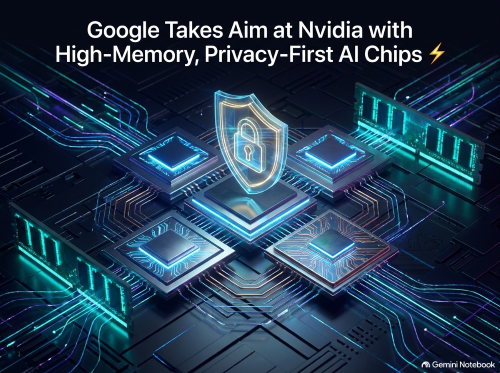
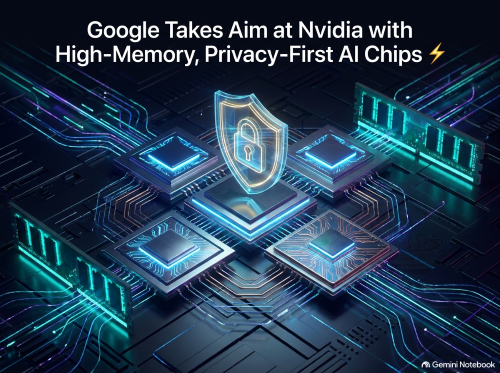
Nvidia has long held a dominant position in the artificial intelligence hardware market, but as AI evolves from basic conversational chatbots to autonomous agents, infrastructure requirements are shifting rapidly. Modern enterprise workloads demand hardware that can process confidential corporate data without security risks, alongside architectures capable of handling vast memory requirements.
In response to these demands, Google has expanded its eighth-generation Tensor Processing Unit (TPU) portfolio with two custom systems: the TPU 8tx and the TPU 8i Max. As highlighted in recent coverage of Google's strategy to challenge Nvidia, these specialised additions represent a direct push to capture enterprise AI workloads by addressing data protection and memory performance.
For heavily regulated sectors such as financial services, healthcare, and government, deploying AI models on sensitive internal data presents a significant security hurdle. Standard encryption protocols secure information when stored on disk or transmitted across networks, but processing that data traditionally requires decrypting it in system memory, leaving it vulnerable during active computation.
The TPU 8tx addresses this issue by integrating hardware-level confidential computing directly into the processor architecture. Built on TPU 8t silicon, paired with fifth-generation AMD EPYC host processors, and linked through Google's low-latency Boardfly network, the system keeps customer data and proprietary model weights isolated even while in active use.
Crucially, this added hardware security operates with a near-zero performance penalty. Compared to the standard TPU 8t, the TPU 8tx cuts latency by up to half, ensuring that security-focused applications remain responsive. Organisations can now fine-tune foundation models, execute reinforcement learning, and run autonomous agents on private datasets within a single secure cluster, avoiding the operational risks associated with migrating sensitive data across separate systems.
Beyond data privacy, enterprise AI infrastructure faces another obstacle: the memory wall. Modern AI agents are increasingly tasked with reasoning across million-token context windows, analysing entire software codebases simultaneously, or processing hours of high-definition video. Traditional processor designs struggle to shuffle these immense volumes of data in and out of memory without causing execution delays.
Rather than undertaking a multi-year effort to manufacture an entirely new silicon chip, Google adopted a system-level engineering approach for the TPU 8i Max. As detailed in Google Cloud's official TPU announcement, engineers combined two TPU 8i chips into a single unified package.
This dual-chip design scales compute performance and memory bandwidth in lockstep. By doubling the compute capacity, on-chip SRAM, and High-Bandwidth Memory (HBM) throughput within the exact same rack footprint, data centres can double their processing density per square metre without requiring facility redesigns. To support this hardware, Google has also open-sourced TPU Sync, a software layer that manages memory across chips, host DRAM, and network storage to reduce data-transfer delays and startup times by over 90 per cent.
With the launch of the TPU 8tx and TPU 8i Max alongside the existing TPU 8t (built for large-scale model training) and TPU 8i (focused on real-time inference), Google has introduced four specialised TPU configurations in a single year.
At the same time, Google is working to reduce software friction for developers accustomed to Nvidia's CUDA ecosystem. Through open-source tools like TorchTPU, software teams can run native PyTorch and Hugging Face models on TPUs without rewriting their underlying code.
As AI developers look to diversify their hardware supply chains and reduce reliance on a single chip vendor, Google's combination of hardware-level privacy, doubled memory bandwidth, and flexible software tooling offers a distinct alternative for enterprise AI deployment.
Disclaimer: This article is provided for informational purposes only, mistakes may be made, and it's not offered or intended to be used as legal, tax, investment, financial, or any other advice.