x




For organisations navigating the generative AI boom, the ultimate dilemma has never been about capability—it has been about trust. How do you leverage the immense reasoning power of cloud-based frontier models without handing over sensitive corporate IP, proprietary legal briefs, or confidential financial forecasts to external servers?
Perplexity has introduced a solution: hybrid compute for its agentic platform, Computer.
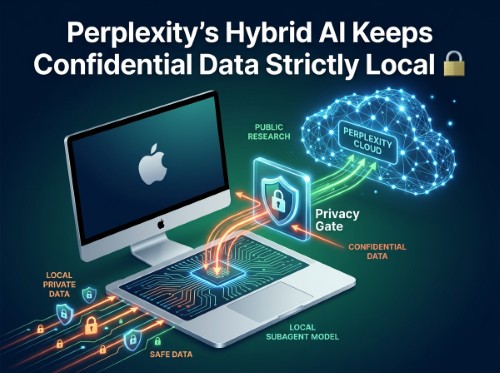
By creating a system that seamlessly splits workload between high-powered cloud models and smaller, open-weight AI models running locally on Apple silicon Macs, Perplexity allows enterprise teams to keep sensitive data on their own devices without sacrificing overall intelligence.
Historically, AI deployment forced a strict choice: run everything locally on limited hardware, or offload everything to the cloud and accept the inherent privacy risks. Perplexity’s hybrid compute architecture dismantles this trade-off by acting as a dynamic workload dispatcher.
When a user initiates a complex task, a frontier model operating in the cloud plans the overarching workflow, handles broad web research, and performs heavy logic reasoning. However, as soon as the task requires interacting with private local files or internal data, the cloud orchestrator delegates those specific subtasks down to a subagent running locally on the user’s Mac.
Crucially, this hand-off occurs dynamically within a single continuous job. The user does not need to restart their prompt, transfer files manually, or stitch together fragmented outputs. The local model completes its assigned portion on the device and returns only the necessary non-confidential tokens or final results back to the orchestrator.
At the heart of this hybrid approach is what Perplexity terms the Privacy Gate—a specialised PII (Personally Identifiable Information) classifier trained by Perplexity that runs locally inside the macOS desktop application.
Before any token or file snippet is transmitted to the cloud, the Privacy Gate scans the payload on the device for sensitive elements, including:
If the Privacy Gate flags sensitive content, the system prompts the user, giving them explicit control over whether that portion of the workflow should remain entirely local or be shared with the cloud.
From a cost perspective, this design also delivers economic efficiency. Token generation taking place locally incurs zero credit charges for the user, as it relies on the machine's own processing power and electricity. Cloud credits are reserved strictly for high-level orchestration, broad research, and complex delegation.
To demonstrate the practical impact of hybrid computing, consider how this technology reshapes daily operations across high-consequence industries:
1. Legal Research and Drafting
A lawyer working against a tight deadline can instruct the agent to revise a confidential court filing using privileged client files stored on their Mac. While the local model processes the private text strictly on-device, the cloud agent simultaneously searches public databases for relevant case law, returning anonymised legal context without exposing client information.
2. Private Equity and Valuation
A financial associate can set an agent to refine an internal financial model using sensitive management projections. The local subagent handles the internal spreadsheet data, while the cloud orchestrator pulls public market comparables to generate a comprehensive investment committee deck in the background—saving hours of manual data collation.
3. Cross-Device Remote Continuity
A business founder travelling between meetings can initiate a complex market analysis from an iPhone. The system securely connects back to their studio Mac, activating the local subagent to process private sales data on the desktop while fetching external competitor pricing from the web via the cloud.
To power the local processing layer on macOS, Perplexity offers a choice of open-weight models, including Google’s Gemma E4B, Alibaba’s Qwen3.6 35B-A3B, and a custom Perplexity post-trained variant of Qwen3.6.
The inclusion of Chinese-developed models like Qwen in enterprise settings often raises security questions. However, running open-weight models locally neutralises traditional cloud-based data security risks. Because the model weights execute entirely on the local machine, no data is sent to external servers overseas.
Furthermore, local execution is constrained by macOS’s native sandboxing framework (Seatbelt). If a local execution attempt tries to access unauthorised directories or execute unapproved actions, the operating system halts the process and requests explicit user permission. Enterprise administrators can also enforce organization-wide privacy policies and review comprehensive audit logs detailing every external data movement.
Perplexity’s move mirrors broader enterprise trends identified by leading analysts like Gartner, who designated hybrid computing among the key strategic technology shifts for modern architecture.
As regulators and standards bodies (such as NIST) continue to highlight data leakage as a primary risk of generative AI, the market is moving away from perimeter-only defences. Rather than trying to build ever-higher walls around cloud servers, the future of enterprise AI lies in building smarter, device-level gatekeepers.
By orchestrating the strengths of cloud-scale frontier models alongside the unyielding privacy of local hardware, hybrid compute sets a new standard for how sensitive work gets done in the AI era.
Disclaimer: This article is provided for informational purposes only, mistakes may be made, and it's not offered or intended to be used as legal, tax, investment, financial, or any other advice.