x



Because the thing you're afraid of revealing was never what the client was buying.
The fear is real and almost universal: if I tell them AI drafted this, they'll think I didn't do it — and then why am I charging this much? So most founders say nothing. Then, eventually, a client asks directly. And now a perfectly fair answer arrives in the worst possible frame, because it's arriving second.
That's the whole mechanism. Told first reads as confidence. Told second reads as damage control — even when nothing was hidden, even when the answer is identical. The only variable is who spoke first, and it's the variable you control right up until the moment you don't.
Not the typing. Nobody has ever paid a professional for keystrokes, and nobody ever paid a bookkeeper for the arithmetic either — the calculator settled that argument forty years ago and the profession got more valuable, not less.
They were paying for judgement. For someone who can look at a draft and know which paragraph is wrong, which number needs checking, which recommendation would blow up in month three. That skill is not diminished by the draft being machine-generated. If anything it's the scarcer half now, because drafts got cheap and checking didn't.
Which means your disclosure isn't an admission that a machine did your work. It's a clarification that you did the part that mattered. Those are different sentences with different consequences, and most founders are writing the first one in their head while the second one is available.
There's a practical test for this. If you removed AI from your process entirely and your client got the same outcome three days later at twice the price — what exactly were they buying? Almost always the answer is: the outcome, and confidence that it's right. Neither of those is threatened by disclosure. Both are threatened by discovery.
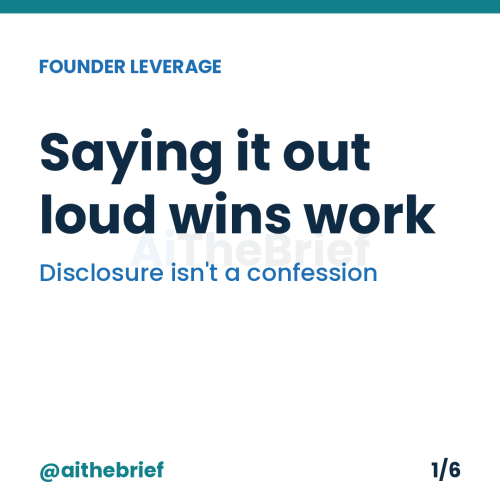
One line, near where you describe your process. Three parts:
That's the whole intervention. It goes in the proposal rather than the contract, because the proposal is read and the contract is signed — a distinction worth internalising if you've ever wondered why nobody reacts to your terms.
Three things happen once it's in there, and the third one is the surprise.
The awkward question stops coming. You answered it before it formed. Clients who would have asked simply read the line and move on.
Price conversations get easier. Once the line names judgement as the thing you're supplying, the discussion shifts from hours to outcomes — which is where you wanted it anyway, and which is the unfinished business from AI making you faster without your prices noticing.
Cautious clients self-select in. This is the counterintuitive one. The clients most nervous about AI are usually the ones in regulated industries, handling sensitive data, with the most to lose — and they are frequently the best-paying clients you can get. They are not looking for a supplier who doesn't use AI; that supplier is getting rarer and slower every month. They are looking for one who can describe exactly how they use it and where the human sits. A clear disclosure is the closest thing to a qualification you can put in a proposal.
Some will. It's worth being honest about that rather than pretending disclosure is costless.
But look closely at what the bad reaction is. It's almost never "you used AI". It's "you used AI on the part I thought you were doing" — the analysis, the advice, the judgement call. That's not a disclosure problem. That's a boundary problem, and the disclosure surfaced it early enough to fix, which is the cheapest time to find out.
If a client's objection survives a clear explanation of where the human sits, you've learned something valuable at proposal stage instead of at delivery. The alternative isn't a happier client. It's the same conversation later, with work already done and a relationship already priced.
Set the line before you need it. Write it into the template, not into an email you compose while defensive — the version you draft calmly is always better than the version you draft in reply, and you can't retrofit "told you first".
Educational only — evaluate your own business risks; results may vary.
For the prompt set we use to draft proposals and pressure-test the wording — free, 5-min read: 7 AI Prompts That Run a One-Person Business.
Related Decodes
AI the Brief (@aithebrief) — AI advice you can act on and trust, for time-starved founders.
TL;DR: Founders hide their AI use because they fear clients will think they didn't do the work — so they say nothing, a client eventually asks, and a fair answer arrives in the worst possible frame. Told first reads as confidence; told second reads as damage control, and the only variable is who spoke first. Clients were never paying for keystrokes; they were paying for judgement — knowing which draft is wrong and why — which disclosure clarifies rather than undermines. Put one line in the proposal, not the contract: the tasks AI assists with, the review you personally do, and what stays fully human. Three things follow: the awkward question stops coming, price conversations shift from hours to outcomes, and cautious clients in regulated industries — often the best-paying ones — select themselves in.