x




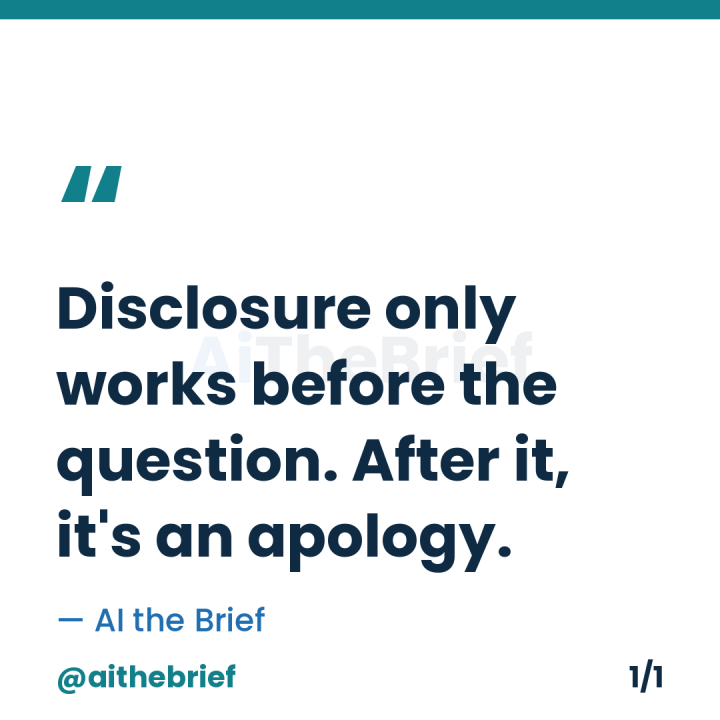
Because disclosure is not information. It's a signal, and signals carry meaning from their timing rather than their content.
Say "we use AI for first drafts and I review everything" in a proposal, unprompted, and it reads as a supplier who has thought about their process. Say the identical words in reply to "did you use AI for this?" and it reads as a supplier who was caught. Same facts. Same sentence. Completely different meaning — and the only variable is who spoke first.
This is the asymmetry the whole week has been circling, and it's worth naming plainly on the last day: you cannot retrofit "told you first." It's the one property of a disclosure that can't be added later, at any price, by any amount of good faith.
It means "we'll mention it if they ask" is not a policy. It's a decision to hand the timing to somebody else, and timing is the entire value of the thing.
It also means the cost profile is inverted from how it feels. Writing your AI line on a quiet Tuesday costs twenty minutes and feels unnecessary, because nobody has asked. Writing it in reply to a client who noticed costs a considerably worse afternoon and buys you a weaker version of the same sentence. The work is cheapest exactly when it feels most optional — which is a general law of this kind of work, and the reason the escalation rule gets written first rather than after the incident that needed it.
And it means most of the value of this week's work is already banked if you did it. The audit, the three sentences, the policy page — none of those are impressive documents. They're just early ones. Earliness is the whole product.
Almost everywhere trust is the asset, which is why it's worth extracting from the AI context before you file it.
Price changes. Told in advance: a business managing itself. Told when the invoice arrives: a business hoping you wouldn't notice.
Delays. Flagged on Tuesday for a Friday deadline: professional. Explained on Friday: an excuse, regardless of the reason, which may well be identical.
Mistakes. The one you raise yourself costs a conversation. The one a client finds costs the assumption that you'd have told them — and that assumption is worth more than the mistake, because it was doing work across every other piece of your relationship.
Limits. Saying "that's outside what I do" at the start reads as expertise. Saying it in month three reads as a retreat.
The pattern is consistent enough to be useful as a working rule: in any relationship where trust is the actual product, the value of a fact is set by who says it first. Not by how bad it is. Not even by how well you explain it. AI disclosure is just the version of this that acquired a date in August 2026 — the underlying rule was always operating, and every founder who has ever been caught out by it already knows this in their body.
Notice what the rule doesn't say, though. It isn't an argument for volunteering everything. A supplier who narrates every internal wobble isn't trustworthy, they're exhausting, and the constant disclosure devalues the signal it was supposed to send. The test is narrower and easier: would this change how they'd have decided? If yes, say it first. If no, it's your problem to carry, and carrying it is part of what they're paying for.
Nothing heroic. The honest answer is that this week's work is small, and its smallness is the point — twenty minutes of audit, ten minutes of sentences, half an hour of policy page. An hour and a bit, in exchange for permanently owning the timing on a question that will otherwise be asked of you by someone else, at a moment of their choosing.
If you've done it, the useful Sunday exercise is the extraction: where else are you currently relying on nobody asking? There's usually one. A rate that hasn't been mentioned. A subcontractor. A limitation you'd rather introduce gently. That thing is generating a small, constant tax on your attention, and telling first is what stops the meter.
If you haven't done it, do the twenty-minute audit. Everything else follows from having the list, and the list is the only part that requires you rather than a template.
This has been a week about a regulation, but the regulation was only ever the deadline. Speed stopped being the premium a while ago; what's left to compete on is whether people find out things from you or about you. That's not a compliance question. It's the whole business.
Say it out loud. Say it first.
Educational only — evaluate your own business risks; results may vary.
For the prompt set we use to run this week's checks — free, 5-min read: 7 AI Prompts That Run a One-Person Business.
Related Decodes
AI the Brief (@aithebrief) — AI advice you can act on and trust, for time-starved founders.
TL;DR: Disclosure is a signal rather than information, so its meaning comes from timing rather than content — the same sentence about AI use reads as a considered process when offered unprompted and as damage control when given in reply to a question. That property cannot be added later, which makes "we'll mention it if they ask" a decision to hand the timing to someone else. The cost profile is inverted from how it feels: writing the line on a quiet Tuesday costs twenty minutes, writing it after a client notices costs far more and buys a weaker version. The rule generalises beyond AI to price changes, delays, mistakes and limits — in any relationship where trust is the product, the value of a fact is set by who says it first. The regulation was only ever the deadline.