x




We hold publishing rights to 546 files — 67 finished products, 338 editable source documents, sales letters, covers, the lot. We have published none of them. Not one, in more than two years of holding those rights. The reason isn't that the rights lapsed and it isn't a lack of time. The library failed four checks, and those four checks now run on anything that goes out under our name.
If you have a drawer like this — content you bought, files an agency left behind, a folder of AI drafts from a project that died — this is the test. It takes an afternoon, and it will be the cheapest afternoon of your quarter.
We audited ours properly rather than guessing: 546 files, roughly 460 MB, across five collections. Sixty-five of 67 products complete with editable source, a sales letter and cover art. Three hundred and thirty-eight editable documents — which matters, because content you can't rewrite is worth almost nothing.
Licence files found: zero. Revenue generated to date: zero.
That second number is the honest one, and it's worth sitting with. At the point of purchase, every one of these was going to be a business.
Not "do you have the rights". Can you produce the actual document?
We searched all 546 files for a licence, a terms file, a readme. Nothing, across five collections. And that matters more than it sounds, because rights of this kind are never one permission. They vary on every axis that decides what you can actually do: whether you may claim authorship, give the file away, bundle it, sell it on a marketplace, put it behind a membership, or publish it to Amazon.
Two years of holding rights is not the same as knowing which rights you hold.
Until the grants are recovered, nothing commercial is scopeable. That isn't caution for its own sake — it's the same vet step we'd apply to any tool before recommending it, and the 15-minute review that keeps you out of trouble applies to content you own just as much as to tools you rent. We wouldn't let a client publish on this basis, so we don't.
(We're not lawyers. This is how we run our own shop, not advice for yours.)
Content sold to many licensees is, by design, sitting in many drawers. The same libraries circulate widely, which means the words you're about to publish may already exist under a dozen other names — and platforms have got considerably better at noticing.
The check is quick: paste a distinctive sentence into a search engine. If it comes back wearing someone else's byline, you're not publishing an asset, you're joining a queue.
Write the sentence you'd put in your own front matter describing exactly how this was produced and what you did to it. If you'd wince reading it aloud to the person you most want as a client, you have your answer.
Here's the part we won't skip: we haven't read all 546 files. We can't tell you the content is bad. What we can tell you is that we can't verify it's good — no sources, no dates, no named author, no way to check a health or money claim written by someone unknown at an unknown time. "We haven't verified this" is always sayable here. It's also disqualifying for anything that ships.
This is the one almost nobody runs, and it's the one that decided it for us.
Publishing widely-duplicated material would go out through the same publishing account a real book depends on. Trading an account that carries years of future work for commodity ebooks at ten or twenty pounds each is a bad trade — and it's only visible if you ask what's downstream of the upload button.
The general form of the question: what does this touch that I can't replace? An account, a domain reputation, a professional registration, a client relationship. Speed is cheap now; trust is the premium — and the fastest way to spend the premium is to publish something you can't stand behind.
Run the four checks on one item, not the whole library — twenty minutes. Licence, duplication, disclosure, account risk. Anything that fails check one or four stops there.
Then be honest about what's left, the same way you'd score any tool by what it actually returns. Assets that can't be published aren't assets; they're a lesson you've already paid for, and the lesson has real value — ours is the clearest evidence we own that acquiring things and building something are different activities.
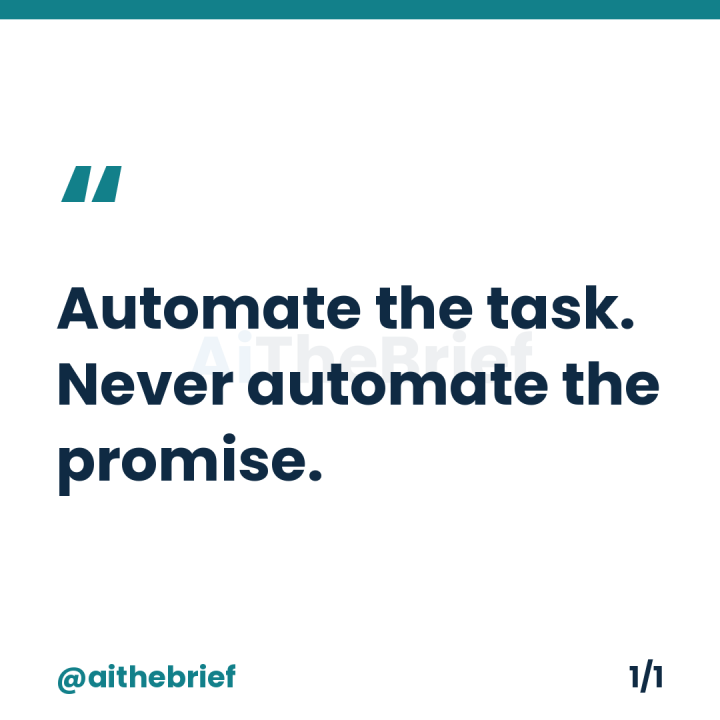
That's the trust boundary applied to publishing rather than automating, which is this week's bigger question about what you hand over and what stays yours. Automate the task. Keep the promise. And don't publish anything you'd have to explain.
Want the same treatment for where your week actually goes? The 10-Hour Audit is our free 5-min read — comment AUDIT on Instagram, or grab it from the link in bio.
Related decodes
TL;DR: Owning content isn't permission to publish it. Before publishing anything from a drawer of bought, inherited or AI-drafted files, run four checks — can you produce the actual licence, how many others are publishing the same words, could you state out loud how it was made, and what does publishing it risk that you can't replace. We hold rights to 546 files, found zero licence documents among them, and have published none.

This week's card — the trust boundary in one image.
AI the Brief (@aithebrief) — AI advice you can act on and trust, for time-starved founders. One decoded AI move, every week. Follow @aithebrief on Instagram for the daily version, or subscribe free on Substack for the deep one.